
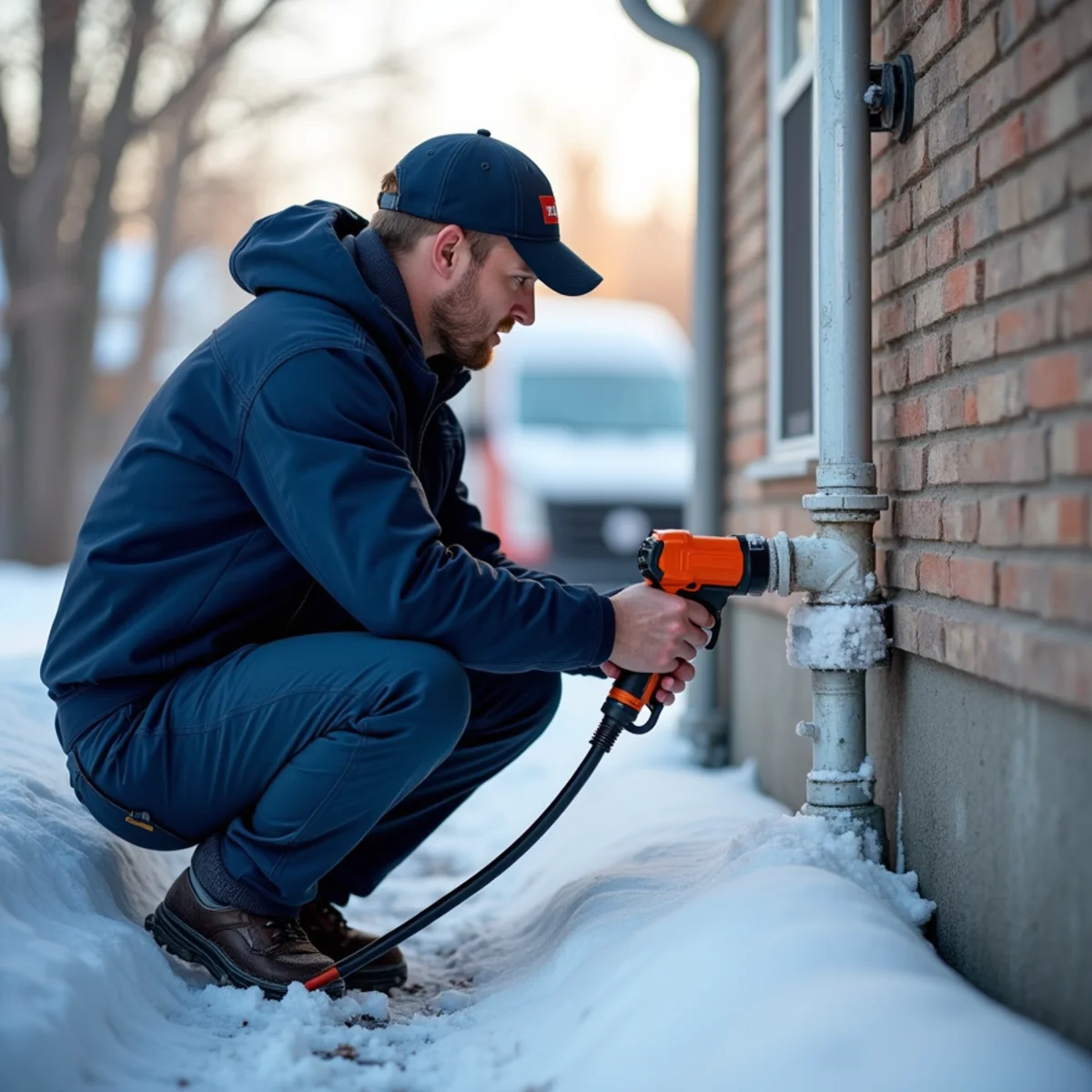
Michigan winters put every home's plumbing to the test. January lows near 17°F freeze the most vulnerable lines first — those in exterior walls, crawl spaces, attics, unheated garages, and at hose bibs. A frozen pipe is a two-part emergency: the freeze itself, and the split that often reveals itself only when the line thaws and water starts flowing again.
We thaw frozen lines safely — never with an open flame — locate any splits, and repair them before they can flood your home. If your home is vacant or you are heading south for the winter, we can also help you protect it so you do not return to a disaster.
Think a pipe is frozen? Do this now
January lows near 17°F freeze the most exposed lines first — exterior walls, crawl spaces, attics, hose bibs, and vacant homes. A freeze is a two-part problem: the ice, and the split that often shows only when it thaws.
Safety first. Never thaw a frozen pipe with an open flame — it can crack the pipe or start a fire. Keep the affected faucet open, and locate your main shutoff in case the line has already split.
If a pipe is frozen
- 1Keep the affected faucet open so water can flow as the line thaws.
- 2Locate your main water shutoff in case the pipe has split.
- 3Apply gentle, safe heat — a hair dryer or warm towels — from the faucet end toward the freeze.
- 4If you cannot reach or safely thaw the line, or it has split, call us.
If it has already burst
- 1Move away from any water near outlets, the panel, the furnace, or appliances.
- 2Shut off the main water supply and open a cold-water faucet.
- 3Move valuables out of the water path and photograph the damage from a dry spot.
- 4Keep the main off until we inspect — a freeze can crack a pipe in more than one place.
What to say on your first call
- Which fixture or area lost water?
- Is any pipe visibly split or leaking now?
- Can the main water shutoff be reached safely?
- Where is the frozen run — exterior wall, crawl space, or attic?
- Is the home vacant or under-heated?
Stop it from happening again
- Insulate exposed lines in exterior walls, crawl spaces, and attics.
- Disconnect and protect hose bibs before winter.
- Keep safe heat in vacant homes and arrange periodic checks.
- Have us winterize the plumbing before you travel for the season.
When to call us for frozen pipe repair
No water from a faucet in the cold
A fixture that stops flowing during a freeze usually means the line to it is frozen. Keep it open and call us.
Frost or bulging on a visible pipe
Visible frost or a swollen section means the line is frozen and may already be cracked.
Water appears as it warms up
A split from freezing often leaks only once the ice thaws — keep the main off until we inspect.
A vacant home during a cold snap
Empty homes are the highest freeze risk. If yours sits vacant, protection is far cheaper than repair.
What's included in our frozen pipe repair
Every frozen pipe repair job is a complete, documented service — not a quick patch. Here's what you can expect when our licensed team is on site.
- Locating the frozen section — exterior wall, crawl space, attic, or hose bib
- Safe, controlled thawing with no open flame
- A full-run pressure check, since a freeze can split a pipe in more than one place
- Permanent repair of any cracked or split section
- Insulation or rerouting advice so that line does not freeze again
- Winterization for vacant or seasonal homes on request
Our process
- 1
Locate the freeze
We find the frozen section — usually along an exterior wall, crawl space, or unheated area — before thawing.
- 2
Thaw safely
We thaw the line with safe, controlled heat, never an open flame, to avoid cracking the pipe or starting a fire.
- 3
Inspect for splits
We pressurize and inspect the whole run, because a single freeze can crack a pipe in more than one place.
- 4
Repair & prevent
We repair any splits and recommend insulation or rerouting so that line does not freeze again next winter.
What affects the price
We never post fake prices. Here's what actually drives the cost — and we put the real number in writing before any work begins.
- Whether the pipe only froze or also split.
- Location and accessibility of the frozen run.
- Number of failure points after thawing.
- Emergency vs. scheduled service.
- Preventive insulation or rerouting to stop repeat freezes.
Why Bloomfield Hills homeowners choose Bloomfield Hills Plumbing for frozen pipe repair
We've served Bloomfield Hills and Oakland County for over 17 years, hold a 4.9-star rating across 138 reviews, and back every job with a licensed Michigan master plumber. Here's what that means for your frozen pipe repair.
We thaw it safely
Never an open flame. We use controlled heat to thaw the line without cracking the pipe or creating a fire risk — then check for the damage a freeze leaves behind.
We find the split before it floods
A frozen pipe often cracks but stays sealed by ice until it thaws. We keep the main off and inspect the full run so the leak doesn’t surprise you later.
Michigan-winter ready
With January lows near 17°F, we know the lines that freeze first here and how to protect them — exterior walls, crawl spaces, attics, and hose bibs.
Prevention, not just repair
After the fix, we insulate or reroute the vulnerable run and can winterize a vacant home so you don’t take the same call next January.
Frozen Pipe Repair FAQs
Keep the affected faucet open so water can flow as it thaws, and locate your main shut-off in case the pipe has split. Do not use an open flame to thaw the line — it can crack the pipe or cause a fire. Call us and we will thaw it safely and check for damage.
Insulate lines in exterior walls, crawl spaces, and attics; disconnect and protect hose bibs; keep the home heated even when away; and know where your main shut-off is. For vacant homes, arrange periodic checks. We can winterize your plumbing before the cold arrives.
Unfortunately, yes. Freezing often cracks a pipe, but the split stays sealed by ice until it thaws. That is why we keep the main off and inspect the full run after a freeze — the leak that appears on thaw is exactly what we are looking for.
Insulate lines in exterior walls, crawl spaces, and attics; disconnect and protect hose bibs; keep the home heated even when away; and know where your main shutoff is. For vacant homes, arrange periodic checks or have the plumbing winterized before the cold.
Pipes are at risk once temperatures drop into the low 20s°F, especially in unheated or exterior spaces where wind and poor insulation speed things up. In Bloomfield Hills, exterior-wall lines, crawl spaces, attics, and hose bibs freeze first.